
 sunrise from Silver Peak, Catalina Island
(Sacrificial) Sails
Quick Links: Overview • DBS • DBS Story Sets • Prayer • solo Bible study • LTGs
Only God can start and sustain movements, so disciple-making depends on the Holy Spirit. But as a sailboat needs its sails up so the wind overcomes its inertia and the water's drag, so God calls and equips disciple-makers to be ready to move when the Spirit blows. These are the so-called 'sails' of disciple-making movements. Each one involves a sacrifice: of scarce time, old habits, and entrenched assumptions.
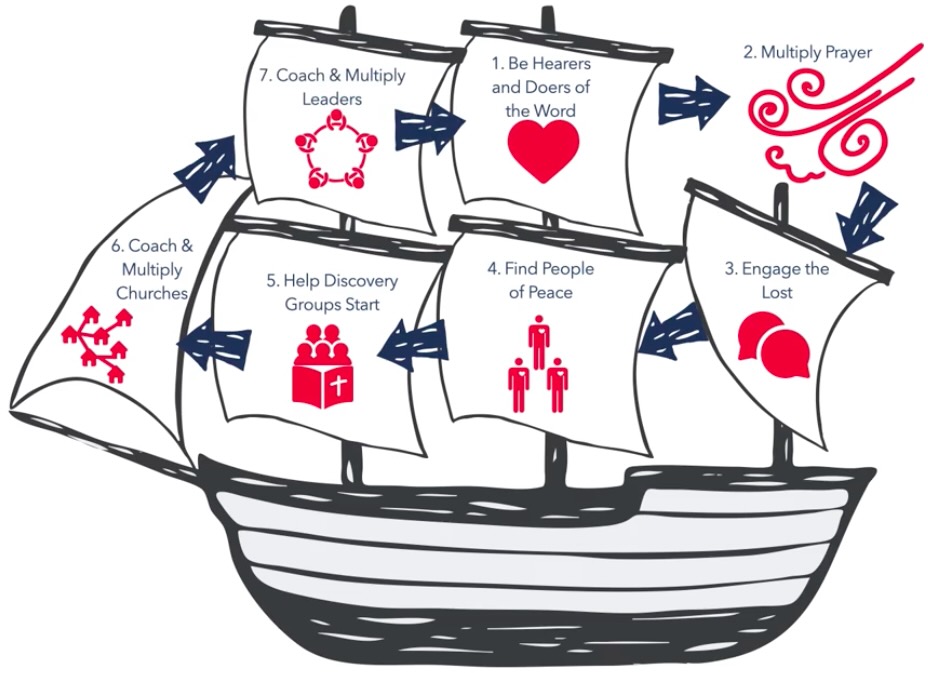
This image is a screenshot from Waha's excellent online orientation to the disciple-making process and its key practices. I highly recommend its first three videos, and assign the series to students for learning disciple-making practices.
Disciple-makers transfer skills and grow habits by MAWLing:
- Modeling something to learn,
- Assisting as the learner tries,
- Watching the learner practice, and
- Leaving/(or, better, Launching) the learner to show others in turn,
so the whole process can replicate over and over.
Other training models simplify these. For instance, Novo's disciple-making cohort names five steps: (These descriptions are lightly edited from Novo's own language.)
- Activating Prayer: A prayer movement precedes every gospel movement. New disciple-making flows from the heart of God, so we pray to align with his heart and purpose, and then to discover and discern where he is already working so that we can join him, rather than asking God to bless our strategies. Declarative prayer, listening prayer, spiritual mapping, prayer-walking, strategic prayer, and other forms harness the spiritual authority God has entrusted to servants.
- Engaging Culture: Once we understand our identity as people called by God with a powerful mission to complete (Matt 28:19–20), we are free to run with purpose and 'live on mission' by blessing others, engaging in spiritual conversations, and discovering spiritually curious people (Luke 10's 'persons of peace'). Such engagement means meeting people's felt needs in Jesus' name and discerning where the Spirit is active and people are receptive. We build authentic relationships with pre-believers where we may invite them into a discovery process where they can become committed and obedient disciples of Jesus.
- Making Disciples: When we live as committed disciple-makers in the neighborhoods and networks God has called us to, we find people God has prepared to hear the good news about Jesus. Instead of pulling people away from their friends and family and pushing them to join a church to be discipled, we simply share the gospel and begin making disciples from the ground up, in the everyday rhythms of life. This classically involves helping them begin 'discovery groups' using Discovery Bible Studies to learn, practice, and share faith in Jesus in their own contexts. This process does not rely on experts, is highly relational, and easily reproduces across settings and cultures.
- Growing Leaders: In a gospel movement, everything multiplies. New disciples grow and multiply other disciples and leaders. Those emerging leaders are equipped and deployed according to their gifting. The only way to see cities and nations reached is to multiply everything at every stage. To sustain a movement, leaders identify new leaders and strategically coach, mentor, and launch (MAWL) them to identify and MAWL new generations of leaders in turn.
- Forming Churches: As disciples grow and learn together, new spiritual families emerge. These simple expressions of church can be referred to in various ways—such as simple church, microchurch, house church, or gathering. In the book of Acts and within gospel movements worldwide, believers' primary gathering occurs within homes and everyday spaces. There spiritual families can love one another, worship and pray intimately together, and be on mission in powerful ways. They are lightweight, inexpensive, and easily reproducible from context to context. When followers of Jesus engage together in worship, community, and mission, they are the church.
Still another helpful path for this process draws on Jesus' parable of the seed growing (Mark 4:26–9), which many disciple-makers call "the four fields":
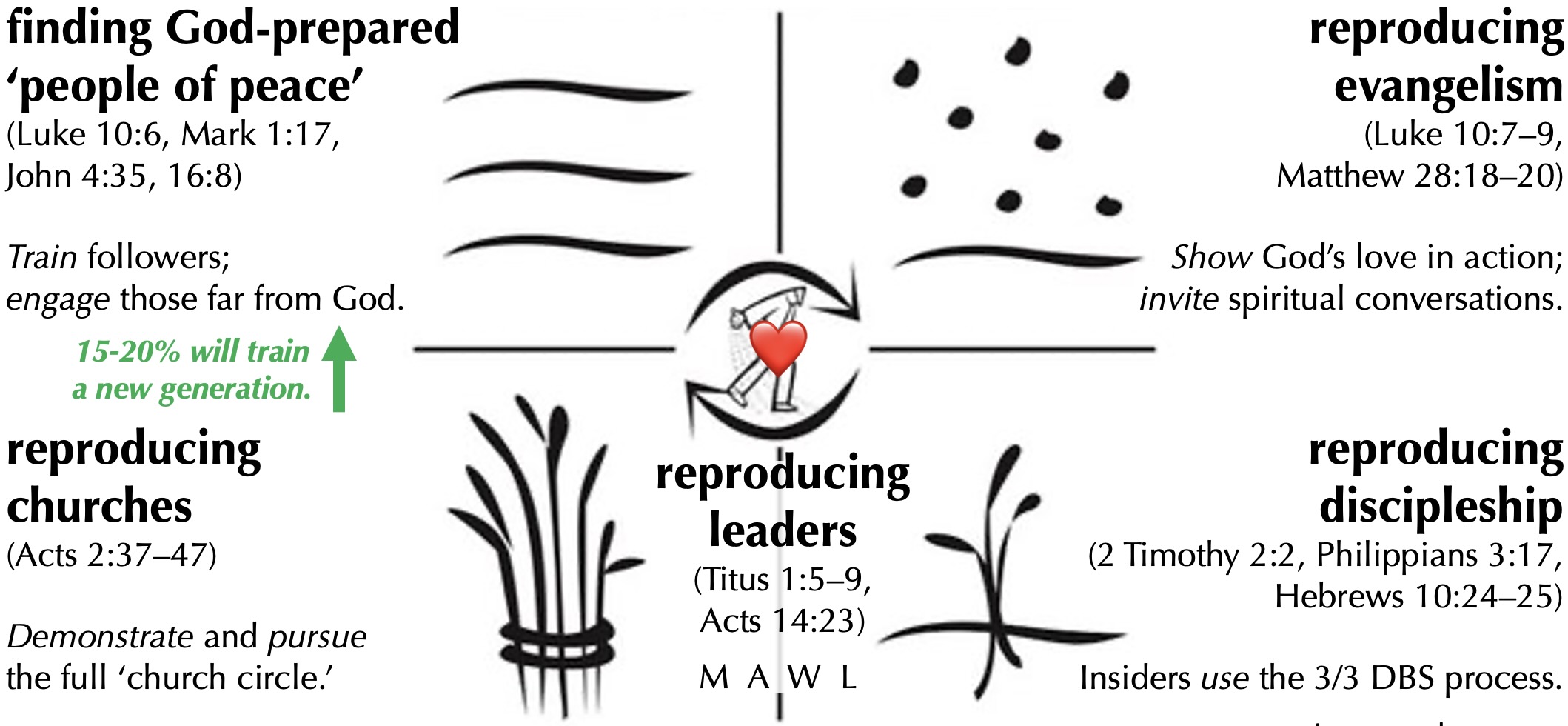
This offers a simple guide for what Jesus' servants do. My Moving Theology lectures also draw connections between the Four Fields and many aspects of Christian teaching including creation, salvation, the biblical phenomena surrounding Jesus' resurrection, the work of the Holy Spirit, and doctrines of the future.